March 13, 2024 2 min

How Taylor Swift protects her intellectual property
Taylor Swift was the first artist to receive seven Grammy nominations for Song of the Year, had eight sold-out shows at the UK`s biggest arena, Wembley Stadium, and became the most popular artist in the history of Spotify and Apple Music. In addition to her musical talent, Taylor has an outstanding business mindset. One of the pillars of her unprecedented success is a well-thought-out strategy for protecting intellectual property. Mariia Yesypovych and Mykhailo Yudin from Axon Partners law firm explored how the world’s biggest pop star protects various components of her creativity, brand, and media identity. Publication for Slukh.
Navigation

Trademarking as a lifestyle
As of today, Taylor Swift has 394 registered and 79 active trademark applications worldwide. 173 of them are in the US, 157 in China (!), and the rest in Canada and other countries. Why so many?
This is not much if your goal is to register as trademarks
Your name:
Your signature:
Your initials and autographs:
Album titles, including re-recordings:
Names of the songs:
The title of an unpublished novel she wrote at the age of 14:
The name of your fan community:
The name of the social media page:
Names of concert tours:
Name of your emoji collection:
Lines from songs and viral phrases from music videos:
Marking of re-recorded albums:
Names of your pet cats
…and something in Chinese
Trademarks are registered for specific goods and services. Taylor registers her trademarks not only for music recordings but also for a wide range of merchandise (clothing, drinks, stationery, musical instruments, etc.), concerts, and various digital media. But Taylor Swift doesn’t stop there.
Re-recording of albums
It turned out to be the best solution for her situation and a model case for the music business. At the age of 15, the singer started working with Big Machine Records. Taylor transferred part of the rights to her songs to the label which was promoting her. In 2018, the contract was about to expire, and she decided to end her collaboration with Big Machine Records.
Taylor unsuccessfully tried to acquire the copyright to her six albums, which belonged to the label. Further, the songs were transferred between companies, but not to Taylor herself, which was prevented by the label’s founder, Scott Borchetta, and Scooter Braun, its new owner and Kanye West’s talent manager. This led to the fact that the musician cannot use or in any way control her own recorded tracks from her first six albums.
How the artist and the label divided the rights
Taylor writes her own songs, and under the contract, the parties agreed that she retains the copyright to the music and lyrics, while Big Machine Records receives the rights to recordings (“masters”) of the tracks of all six albums.
This is standard practice in such collaborations. And, as is also often the case, they could not part ways peacefully because, given the singer’s popularity, it was a matter of a lot of money. To use the masters of her own songs, Taylor would have to buy the rights or obtain a license from the company that eventually became the owner of the rights to them, Shamrock Capital. But the terms offered to Taylor were unacceptable.
At this stage, an exceptional decision was made to re-record the tracks. Taylor retained the exclusive right to perform her songs. Until 2020, the contract prohibited re-recording them, but as soon as this opportunity appeared on the horizon, the artist re-recorded all six of her albums, creating new sound recordings, the rights to which now belong to her completely, fully and without reservation.
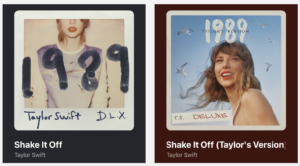
The re-recorded albums were released with the prefix “Taylor’s Version” in the title. These albums do not negate the original recordings and are available online alongside them. Moreover, the new recordings sound as similar as possible so as not to lose the audience that has already become attached to their favorite hits.
Is it possible? Let’s find out.
What and how is protected in the song?
Copyright protects a work’s text, musical composition, and sound recording in the United States. However, the rights to the text and music are separate from the rights to the sound recording, which are directly dependent on the former.
Who owns the rights?
Initially, the property rights to a song belong to the author(s) of the lyrics and music, and the property rights to a sound recording belong to the record producer, and then – as the parties agree under the contract. Non-property rights (the right to acknowledge authorship, the right to demand the preservation of the integrity of the work, etc.) always remain with the authors.
The owner of a sound recording copyright may, among other things, make copies of songs, distribute them, enter into licensing agreements for recording, etc. without violating the rights of the song’s author.
Is this possible in Ukraine?
It is not possible to do the same. According to Ukrainian law, a sound recording is called a phonogram, and the producer of a phonogram has related rights to it as a result of its production:
When producing a phonogram, subjects of related rights are obliged to refrain from actions that may infringe the copyright and/or related rights of others (part 5 of Article 36 of the Law of Ukraine “On Copyright and Related Rights”).
An identical or very similar phonogram is likely to be recognized as an infringement of related rights. At the same time, it is important to consider how the distribution of rights is set out in the agreement between the artist and the label.
Why re-recording does not violate the label’s rights
If the label still owns the rights to the recordings, how can Taylor record almost identical tracks without violating anything?
There is a rule in the US Copyright Act:
The exclusive rights of the owner of copyright in a sound recording do not extend to the making or duplication of another sound recording that consists entirely of an independent fixation of other sounds, even though such sounds imitate or simulate those in the copyrighted sound recording. (17 U.S.C.A. § 114(b)).
That is, according to American law, you can re-record the same songs, even if they are very similar, like Swift and one of her Swifties, it will still be a separate, independent fixation of the works.
It is already safe to say that this strategy has worked. Taylor, as the owner of the copyright to the songs, also retained the so-called “synchronization right”, or the right to use the songs in media, TV shows, video games, and advertising. If you want to use a track, the creator of entertainment content must obtain permission from both its author and the record producer. Swift understood that the label would receive the bulk, if not all, of the contractual profit from such use, so she blocked it on her part, thereby significantly reducing the value of the original recordings and drawing attention to the re-recordings to which she owned the rights.
Be like Taylor
Some may call Taylor Swift’s approach to intellectual property protection expansionist, but given the scale of her popularity, it is hard to blame her. In fact, we are looking at an example of wise management of intangible assets and permanent expansion of protection of her creative portfolio, which ultimately provides the singer with reliable legal tools against most known cases of unauthorized use of intellectual property.
Other post

 Export of Defense Technologies – Key Compliance Rules for International Cooperation in MilTech
May 7, 2026 1 min

 What is the world of internal policies and assessments under the GDPR like?
October 10, 2025 1 min
 Two Galyas, one market: what is happening between the Baluvana Galya and Galya Baluvana chains
July 18, 2025 1 min


